
Tag: Clinic Staffing

Cardiac Remote Monitoring and The Standard of Care

Cardiac Device Clinic Challenges and the Standard of Care

Remote monitoring is often avoided because it is felt that with the addition of remote monitoring, it will completely overburden staff. Remote monitoring can be a source of data overload that can create more work to sort through. Triage of remote alerts can be time consuming and an unpredictable workload on a daily basis.

With increasing clinic size, it is virtually impossible to see all patients in the office on a regular basis. Clinic schedules are often consumed with routine follow-ups that could be done remotely.With the increased complexity and number of devices, clinics are responsible for managing data on multiple sites including Medtronic Carelink, Boston Scientific Latitude, Biotronik, and Abbott Laboratories (St. Jude) Merlin. Several complex data management steps are involved in the process. This includes downloading data from multiple sites, generating reports, reviewing reports, and transferring the reports into hospital EMR systems such as EPIC, Allscripts, and Cerner.

Difficult to find and employ CIED trained, experienced and CCDS staff. The tasks of remote monitoring have traditionally been integrated into a clinician’s already full clinic schedule. Inability to dedicate a staff member exclusively to remote monitoring to maintain the efficiency and quality of remote monitoring. Additional resources required to coordinate a remote monitoring program put additional strain on office and administrative workflow.

Remote monitoring CPT codes such as 93294, 93295, 93296, 93297, 93298 and 93299 are all associated with remote monitoring device patients. Most clinics struggle with maximizing the billing and reimbursement potential, leading to revenue losses. Software solutions are associated with large upfront costs and ongoing subscription fees. Clinics that already invested in a software solution, such as Paceart can find it unreasonable to invest in a different solution or service.

The Standard of Care

Research shows that complementing remote cardiac device patient interrogation with in-person device checks enables healthcare providers to provide a better standard of care to their patients.

Remote monitoring allows the physician to implement an improved strategy and care plan based on review of the patient’s in clinic visits and remote interrogations. While remote monitoring is crucial to a successful delivery of care, hospitals and device clinics have several challenges while monitoring their cardiac patients who have pacemakers, ICDs and ILRs (loop recorders). These challenges are related to workflow, staffing, patient volume and capturing reimbursement potential. Overburdening of the clinics may sometimes lead to backlogs, which further leads to challenges in ensuring quality patient care.

Alert Management

Advancements in remote monitoring technologies have enabled cardiac devices to seamlessly transmit critical data to health care providers.

Remote monitoring alerts practitioners to changes in lead or device function that would otherwise go undetected until the next scheduled in-person or remote interrogation. Remote alert management is able to detect device failure and alert clinicians to possible human programming errors such as the failure to activate tachyarrhythmia therapies. Remote interrogation and alert management technologies complement routine follow-up appointments, while maintaining an in-person evaluation schedule. Studies demonstrate that well-planned remote monitoring and interrogation helps achieve follow-up goals and improve device clinic workflow efficiency.

Better Patient Care

Patients report high satisfaction and acceptance of remote monitoring technology. Clinicians find the data reliable for evaluating device function and detecting arrhythmias while reducing the frequency of in-person evaluations.

Various studies have explored the ability of remote monitoring to detect problems early, thereby improving patient outcomes. Research demonstrates that incorporating remote monitoring into follow-up practice ensures greater patient retention and improves adherence to scheduled patient evaluations. These studies form the basis for the HRS’ recommendation that remote monitoring is the standard of care for patients with CIEDs (including pacemakers, ICDs and loop recorders), with alert-driven follow ups replacing most routine in-person interrogations.

Male doctor smiling with patient

The Advantages of Outsourcing Remote Monitoring and Contract Staffing: Boosting Efficiency and Patient Outcomes

In today’s rapidly evolving healthcare landscape, cardiac device clinics face the challenge of hiring and retaining expert clinical and technical staff who can deliver optimal patient care while improving operational efficiency. The 2023 HRS/EHRA/APHRS/LAHRS expert consensus guidelines emphasize the need for 3 full-time clinical staff members per 1,000 CIED patients to meet the current standard of remote monitoring care. This article explores the significance and influence of highly trained staff in device clinics and introduces an innovative approach that combines outsourcing of both remote monitoring services and contract staffing. Understanding the economic and clinical advantages of outsourcing remote monitoring and utilizing contract staffing helps healthcare providers enhance practice efficiency, financial stability, and reduce the strain of high turnover, ultimately resulting in better patient outcomes. By combining these two strategies, clinics can reap the following benefits:

Cost Savings: Outsourcing remote monitoring services and contract staffing provides significant cost savings compared to in-house monitoring and staffing. Partnering with a specialized remote monitoring service provider and contract staffing organization like PrepMD allows clinics to avoid expenses related to hiring, training, infrastructure investments, and technical support systems.

Expertise and Efficiency: A highly trained and qualified remote monitoring service provider possesses the necessary expertise, experience, and resources to manage and analyze device data effectively. Their specialized knowledge enables efficient data interpretation, timely patient follow-ups, and proactive interventions, leading to optimized patient care and better outcomes. Contract staffing provides access to highly trained professionals, alleviating the burden of recruitment and training for device clinics.

Risk Mitigation: Outsourcing remote monitoring and contract staffing shifts the responsibilities of data management and analysis to specialized providers. This reduces the risk of errors or oversights that could result in adverse events or missed critical patient information. Clinics can leverage the expertise of remote monitoring service providers and contract staff to mitigate risks and improve patient safety.

Financial Transformation through Strategic Partnership: Maximizing Revenue and Enhancing Remote Monitoring Efficiency (A Case Study)

Let’s explore the impact of partnering with PrepMD on a 4,500 patient cardiology clinic to showcase the financial and clinical benefits of outsourcing remote monitoring to leading clinical solutions providers. Prior to the collaboration, the clinic faced resource constraints and struggled with a high volume of transmissions, which hindered their financial performance and remote monitoring operations. 

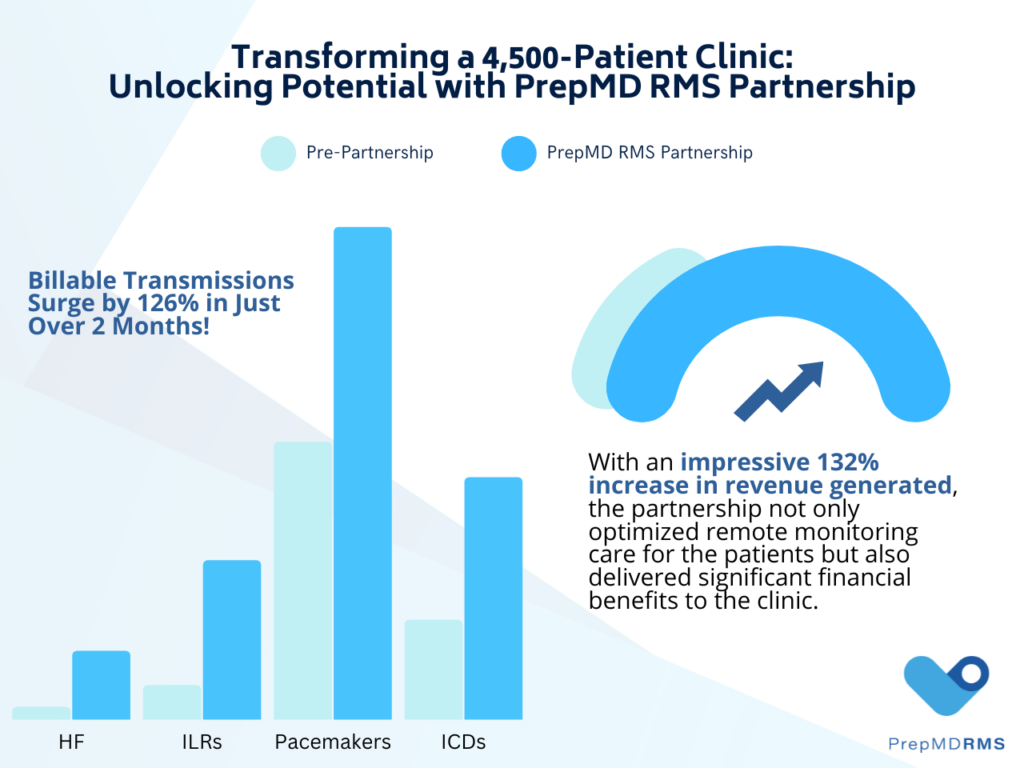
Over a 2-month period, the clinic observed a remarkable transformation. The number of billable transmissions increased by 126%, resulting in a significant 132% rise in generated revenue.

Here is a breakdown of the increase in billable transmissions for specific device types:

  • Heart Failure (HF): 435% increase in billable transmissions.
  • Implantable Loop Recorder (ILR): 361% increase in billable transmissions.
  • Pacemaker (PM): 77% increase in billable transmissions.
  • Implantable Cardioverter Defibrillator (ICD): 143% increase in billable transmissions.

By partnering with the PrepMD Clinic Solutions Leadership Team, the clinic achieved remarkable financial improvements. The increased billable transmissions and revenue growth during the 2-month partnership period demonstrate the effectiveness of the collaboration. The financial gains realized through this partnership highlight the positive impact of leveraging PrepMD RMS services on both the clinic’s financial performance and patient care.

Addressing Staffing and Remote Monitoring Needs:

Partnering with leading cardiac clinical solutions companies which offer bundled contract staffing and remote monitoring service offerings, enables clinics to address their staffing needs economically and effectively. Clinics can retain staff by implementing 1-year or 2-year clinical staffing agreements providing stability, overcoming high turnover rates, and reducing recruitment and training costs. Longer-term commitments foster a supportive work environment, enhance team cohesion, and optimize patient care delivery.

To address the burden of remote monitoring, clinics can partner with PrepMD for premier remote monitoring services that offer a dedicated team of full-time IBHRE-certified professionals that can seamlessly integrate into their workflows. This collaborative approach allows clinics to become self-sufficient while significantly reducing costs, optimizing billing and revenue, and delivering the highest standard of care to their patients with CIEDs.

Conclusion:

Staffing plays a crucial role in cardiac device clinics for remote monitoring, ensuring optimal patient care and streamlined operations. By adopting an innovative and paradigm shifting approach to CIED clinic management that combines outsourcing of remote monitoring services and contract staffing, clinics can achieve enhanced efficiency, financial stability, and improved patient outcomes. The expertise of specialized providers and the utilization of contract staff empower clinics to focus on direct patient care, in-person device checks, and optimizing clinic operations while maintaining the highest standards of care.