Tag: Training & Education

From Fragile to Resilient: Reengineering the Cardiac Device Clinic Lifecycle

Cardiac implantable electronic device (CIED) monitoring is one of healthcare’s largest and longest-standing telehealth service lines. What began as periodic pacemaker checks has evolved into continuous, high-acuity monitoring of increasingly complex cardiac devices. Today, device clinics generate and manage enormous volumes of clinical data that directly influence patient outcomes, clinician decision-making, and cardiovascular service line revenue.

Yet despite its strategic importance, cardiac device monitoring has historically lacked the governance, lifecycle management, and executive visibility applied to other cardiovascular programs. The result is a system that functions—but often under chronic operational strain.


When Instability Becomes Normal

Staffing shortages, workflow fragmentation, growing backlogs, and inconsistent reporting are common across device clinics. Too often, these challenges are treated as inevitable rather than as signals of systemic design risk.

This normalization of instability carries real consequences. Burnout is widespread across cardiology roles, and workload has been identified as one of its strongest predictors. Workforce strain fuels turnover, disrupts continuity of care, and creates revenue leakage through delayed review, billing backlogs, and lost capacity.

The issue is not simply filling vacancies or adopting new tools. As management theorist Peter Drucker noted, some challenges reflect structural discontinuity and require transformation- not incremental fixes.


The Reactive Trap

Most cardiac device clinics operate reactively. Vacancies trigger overtime or redistribution of work. Backlogs prompt short-term fixes. New technology is layered onto existing workflows without clear ownership or governance.

While these responses keep clinics afloat, they limit scalability, predictability, and resilience. By focusing on today’s problems, leaders miss the opportunity to redesign the full operational life cycle- staffing, training, workflows, and technology- as an integrated system.


The Real Problem: A Broken Lifecycle

Many device clinics operate within a recurring attrition loop. Staff leave, replacements are difficult to source, backlogs accumulate, and remaining team members absorb the load- until burnout drives the next departure.

Because this dysfunction is absorbed at the operational level, executive oversight is often limited. Fragmented reporting and diffuse ownership obscure the cumulative impact on clinical quality, workforce stability, and financial performance.

At the same time, remote monitoring technology has increased operational complexity. Clinics manage data across multiple proprietary portals, often requiring manual reconciliation and offering little visibility into cumulative workload. Technology alone cannot stabilize a broken lifecycle.


Reengineering the Service Line

Sustainable improvement requires more than patching gaps. It requires operational lifecycle reengineering.

Drawing from Agile management principles increasingly applied in healthcare, lifecycle reengineering emphasizes value-driven delivery, multidisciplinary collaboration, transparent metrics, and continuous adaptation. Applied at the cardiac device service line level, this approach shifts leadership focus from isolated fixes to system design.

The critical question becomes:
What operational model prevents instability from recurring?


Staffing as Infrastructure

Staffing instability is among the most visible and costly elements of lifecycle failure. Recruitment, onboarding, productivity loss, and turnover create significant financial and operational drag—especially in specialized cardiac roles.

Burnout is tightly linked to workload design, not just headcount. This has driven growing recognition of hybrid staffing models that combine in-clinic teams with remote or supplemental support. When aligned with standardized workflows and clinical governance, these models stabilize workload variability, preserve continuity of care, and protect service line throughput during workforce transitions.

PrepMD was built around this reality- providing scalable staffing support that integrates into existing device clinic operations. Rather than functioning as a takeover, PrepMD partners with the clinic team to assess operational needs, identify pressure points, and design customized support models that align with the clinic’s goals, culture, and governance structure.


Training as Retention and Bench-Building

Training remains one of the most underutilized levers for stability and retention. Structured, tiered education strengthens competence, confidence, and job satisfaction while preserving institutional knowledge that is difficult to replace after turnover.

Embedding education into the operational lifecycle – through accredited learning, mentorship, and formal succession planning- creates a ready bench of cross-trained professionals. Clinics that invest in continuous development reduce downtime, mitigate burnout cascades, and maintain performance during transitions.

PrepMD’s education-first model reflects this philosophy: training is not an add-on, but core infrastructure for service line resilience – delivered in collaboration with clinic leadership to strengthen internal capability rather than replace it.


Technology That Connects the Lifecycle

Remote monitoring technology has expanded access to care but often remains siloed, focused on data aggregation rather than operational integration. Without alignment to staffing models, training pathways, and governance frameworks, software alone cannot stabilize a service line.

A sustainable model treats technology as connective tissue – linking people, processes, and performance metrics into a unified operational framework. When designed for lifecycle alignment, technology enables transparency, accountability, and continuous improvement rather than adding friction.


From Reactive to Resilient

Cardiac device monitoring is essential to modern cardiovascular care, yet it has long operated without the lifecycle discipline applied elsewhere in healthcare. The result has been persistent instability, workforce strain, and financial leakage.

Breaking this cycle requires leaders to move beyond isolated fixes and adopt a lifecycle perspective- integrating staffing, training, technology, and governance into a cohesive system. When aligned, CIED monitoring can evolve from reactive to resilient, supporting both patient outcomes and service line performance.

At PrepMD, this lifecycle-based approach is grounded in partnership. We work alongside clinic teams to evaluate operational realities, co-design customized solutions, and strengthen the systems already in place- building resilience together rather than replacing what works.

Business professionals lined up

Case Studies: Partnering with a Corporate Training Solutions Company for Cardiac Clinical Training Needs

How do Med Device Corporations Benefit from Partnering with A Specialized Corporate Training Provider

Medical device corporations face the ongoing challenge of ensuring their current teams and new hires are equipped with the latest clinical knowledge. This is where a partnership with a specialized training provider like PrepMD becomes invaluable. Such corporate training providers will be able to augment the clinical training teams, enabling corporations to focus on advanced product-specific education.

Partnering with a company like PrepMD that offers extensive online and onsite training solutions, lays down a solid foundation for a variety of roles, including clinical staff and sales teams. Beyond direct clinical roles, corporations may be able to equip cross-functional teams—like engineering and marketing—with essential cardiac knowledge, empowering them to excel in their respective tasks.

Following are case studies that exemplify the success of our collaborative training initiatives with leading medical device corporations:

CASE STUDY 1: Global Medical Device Company Product Launch

The Corporate Training Need
Team Transitioning to Clinic Sales

The Solution
This client was approaching a commercial launch of a new product and asked PrepMD to customize a training solution for their clinical team who would be transitioning to clinical sales responsibilities. This onsite training focused on sales in the cardiac clinical space, using selling skills assessments, sales training, and role playing. The training delivery was launched for their entire regional team as they prepared to go to market with this new product launch. The customized training solution is now the standard on-boarding sales training requirement for all new sales professionals.

CASE STUDY 2: EP New Hires at Global Medical Technologies Company

The Corporate Training Need
EP Fundamentals for New Hires

The Solution
This global medical device company needed an electrophysiology online learning solution for their new hires. After consultation, we helped the client identify their challenges and then designed a customized and branded online solution for them. The all online training solution became the standard for every new hire at the company. The client realized how successful the training was and decided to make it available through their website as a link and a resource to customers. This allowed them to create a customer database of who was more interested in their product and their product training.

CASE STUDY 3: New Salespeople at Global Medical Device Company

The Corporate Training Need
New Salespeople Need Cardiac Foundational Hands-on Training

This global medical device company needed cardiac foundational training for new salespeople. PrepMD designed a cath lab training program with a custom delivery schedule to precede their in-house product training. This allowed employees to more quickly and successfully progress through internal training requirements. The company was so satisfied with the training and employee retention results, this baseline training for all new sales hires was implemented across all divisions.

CASE STUDY 4: Cardiovascular Therapies Startup Product Launch

The Corporate Training Need
Online Learning for New Hires

A startup company in an adjacent medical specialty was transitioning over to the cardiac space for a new indication using their existing technologies. With a team that had no cardiac subject matter expertise, they came to PrepMD prior to product launch to build their company branded training materials for all internal and field sales personnel. This online learning solution became their standard required onboarding training for all newly hired employees.

CASE STUDY 5: U.S. Government Agency Tenured Technical Team

The Corporate Training Need
Quality Control Engineers Need Cardiac Foundational Skills Training

A team of quality control engineers needed cardiac clinical foundation training to communicate effectively with clinicians and scientists. PrepMD conducted online individual assessments to determine needs across the agency, then delivered a lab-based training program on cardiac rhythm management, structural heart, interventional cardiology and related cardiac therapies. Follow-up evaluation and assessment helped ensure comprehension and proficiency.

To explore how a partnership with PrepMD can help you meet your training requirements, please don’t hesitate to submit an inquiry.

Female clinician studying with laptop and books

Continuing Education in Healthcare: 5 Benefits of Online Learning

5 Benefits of Online Learning: Continuing education is an essential part of personal and professional development, especially for healthcare professionals. It helps them to stay updated about the latest happenings, trends, and technologies. Online training and education is one of the most effective ways of continuing education. Some state or employer licensing boards also require you to take certain courses or certifications relevant to your practice. Furthermore, it helps in advancing your career. Within the cardiac device space, the International Board of Heart Rhythm Examiners or IBHRE® conducts examinations for certifications such as CDRMS (Certified Cardiac Remote Monitoring Specialist), CCDS (Certified Cardiac Device Specialist) and CEPS (Certified Electrophysiology Specialist).

For individuals looking to break into the space or for healthcare professionals working in Cardiac Rhythm Management (CRM), Electrophysiology (EP) and Interventional Cardiology (IC)/Structural Heart (SH) who are looking to advance their careers, the PrepMD Accelerator is a trusted online learning resource. IBHRE® Practice Test Kits are also available for those studying for their certification exams.

Five Benefits of Online Learning for Healthcare Professionals:

  1. Accessible Anytime, Anywhere
    Since health care professionals have a busy schedule, it is hard to take time off to take extra courses or training which fits their routine. Through online training, you can study and learn whenever you get free time at work, home or even during commute. You can access the training and learning material on your smartphone, tablet or laptop whichever is feasible for you.
  2. More Interactive
    Online training offers enhanced chances of learning as it provides the learners with abundance of great learning features. Through online training you can take advantage of discussion boards, worksheets, written material, audios and videos.
  3. Less Costly as Compared to Traditional Classroom Learning
    While traditional learning has its own benefits, depending on which stage the you are in your career, it can get rather expensive since you have to pay for the trainer, learning materials, location, not to mention the added expense of transportation. With online training and learning, the cost is less, there are no transportation expenses, and the material is directly emailed to you. Your professional life doesn’t get affected as you can get online training in your spare time. Overall, it actually enhances the quality of service you offer your patients.
  4. High Quality Resource Database
    With online training, you would be provided with a database loaded with high quality resources to help you learn. The database is easily accessible, and you can find whatever information you need to enhance your learning process.
  5. Caters to Different Learning Styles
    Some learn best through listening, some through reading and others through visual interactions. Online training offers all. You have access to written material which you can print, audio lectures, visual presentations and so much more. It enables you to learn at your pace without rushing you on.

The best online learning solutions should include opportunities for customization, online, onsite and hybrid learning formats, as well as needs and proficiency assessments.

The Life Cycle of a Cardiac Device Clinic

A typical cardiac device clinic experiences common same challenges over and over again. The life-cycle of an efficiently run and optimized device clinic contains several universal components. These same problem areas exist in device clinics everywhere and include these primary challenges: staffing, training and remote monitoring optimization and efficiencies.

A Device Clinic Staffing Crisis: Device clinics nationwide are grappling with a staffing crisis as they strive to meet remote monitoring care standards. Recruiting and retaining skilled device techs and nurses is an uphill battle. According to recent HRS guidelines, clinics need 3 device techs for every 1000 CIED patients they manage – a daunting yet critical task.

The Cycle of the Cardiac Device Clinic: Staffing and training challengesCardiac Device Clinic Needs to Hire and Train Staff: The Device Clinic Manager feels as if the recruiting,hiring and training process is never complete. Finding staff that is trained and clinically ready to handle remote monitoring and in-clinic patient care is a tall order. Even after hiring competent clinic staff a Device Clinic Manager may have additional clinic staff in need of training.

Device Remote Monitoring Needs Efficiency and Optimization: The workflow in a device clinic can be overwhelming, so a Clinic Manager is constantly searching for ways to optimize and improve efficiency in the clinic’s remote monitoring with the goal to have a fully efficient device clinic that will elevate the patient outcomes.

PrepMD is the only provider offering a complete solution to cardiac device clinics:

Cardiac Device Remote Monitoring Service

Remote Monitoring Service

Choose PrepMD’s trusted gold-standard cardiac device remote monitoring service, delivered by a full-time IBHRE®-certified team

Cardiac Device Remote Monitoring Software

Remote Monitoring Software
Manage your clinic with our highly intuitive and clinician-developed software, offering SaaS, managed-SaaS and hybrid options.

Cardiac In-Clinic Staffing

In-Clinic Staffing

Meet your ever-growing cardiac clinic staffing needs using PrepMD’s hire, train, deploy, and develop model for in-clinic solution.

Cardiac Healthcare Training

Healthcare Training

Advance the clinical skills of your team with PrepMD’s customizable online, onsite, and hybrid healthcare training solutions.

Male doctor and male patient in clinic setting

CIED Patient Education: What is the Best Time and Place?

Advice on Patient Education and Remote Scheduling of Cardiac Implantable Devices

What is the best time and place for CIED remote monitoring patient education to occur?
Keith Nicholson, CCDS, PrepMD Business Operations Director pointed out that the best time for patient education to occur may be at the wound-check appointment:

“Post-op when the device is implanted, the patient has a great deal of information being thrown at them and it can be very overwhelming. Often, we find that at the wound check appointment the patient will be able to process information more effectively, especially if they are provided with helpful written documentation or FAQs to explain how their monitor works and what the frequency of transmissions will be.”
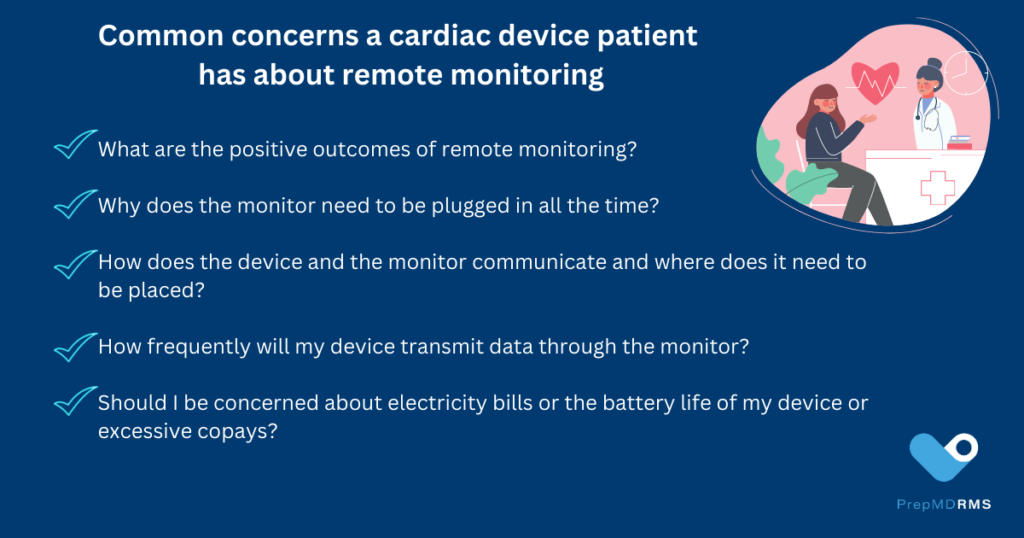

It’s most helpful also at this point if the patient can also be provided a phone number to the specific clinic representative who they can reach out to if they have questions or concerns while setting up their monitor at home.

Patients are oftentimes confused and afraid to ask questions, so having someone who will patiently address their concerns and walk them through setup can quickly result in compliance improvement. It helps to anticipate what the most common patient concerns are that will need to be addressed.

What are typical concerns of a CIED remote monitoring patient?

Is Vendor Technical Service Helpful for Troubleshooting? Some technical issues with the monitors can sometimes require more in-depth troubleshooting just to diagnose the issue. Patients may be confused if they have to deal with multiple individuals for help with their monitor. In this scenario the clinic may find their disconnection rate is occurring more quickly than their recovery rate.

Clinics can and should use the vendor technical service departments for assistance. In fact, Medtronic accepts requests for outgoing calls, where they will place outbound calls to patients to help them troubleshoot with real time instruction. With the other vendors who don’t place outbound calls to patients such as Boston Scientific, Biotronik, Abbott or Merlin, they are always happy to help patients who are calling in for help with reconnecting monitors.

Some patients are much more capable of self-help and other patients may not be technically savvy and may require more assistance. When a patient is directed to call the vendor to troubleshoot connectivity over the phone this can oftentimes be a great success. However, in some cases a breakdown can occur when the patient is asked to call the vendor and they either don’t follow through or don’t have success. 

Remote Scheduling Best Practices
As far as remote scheduling, usually the best practice is to utilize the smart or automatically recurring schedules that exist within the device company websites. This often helps the patient education process, and the patient knows what to expect in terms of scheduled transmissions and copays. Smart scheduling is easily available under the scheduling tab on most vendor websites. Clinics should ideally always use the Smart Scheduling option to ensure coverage of their patient monitoring. Risks of not having patients scheduled include a potential for clinic liability. If a patient is connected but not scheduled the clinically actionable data could be missed. Even with Alerts optimized, summary transmissions sometimes demonstrate something that is clinically important.

Device clinic management is very complicated and each clinic is unique. The PrepMD Clinic Solutions Leadership Team provides solutions to help.

ICD Support Group, Patient Education

ICD Support Groups: A Safe Space to Discuss the Lifestyle Adjustments of a Cardiac Device

“As a healthcare worker I realize that I seriously underestimate the impact on patients receiving an implantable cardioverter-defibrillator (ICD). Besides the patients I have the pleasure of caring for, I do not know anyone personally living with an ICD. Perhaps you do, but I am willing to bet a good majority of clinicians and device specialists do not know firsthand on what life is truly like for ICD patients.”

by Melissa Campbell, CDRMS, PrepMD Remote Monitoring Specialist

According to the JAMA, more than half a million people within the United States have an ICD.1 As common as that may be, I question how healthcare professionals can better understand and serve the needs of ICD patients.

Of course, cardiac device clinics must do their best to provide patient education. Clinics are responsible for patient communication within the brief window of clinic visits and device checks, but that is usually at prompted questions initiated by the patient.  How many patients leave their appointments needing more understanding about their newly diagnosed heart condition and their implanted cardiac device? 

Recent studies suggest that offering an effective ICD support group can provide patients with a safe space to discuss the emotional impact and lifestyle adjustments from having an ICD. 

Benefits of ICD Support Groups:

  • Improved quality of life
  • Enhanced communication with healthcare providers
  • Greater understanding of heart disease and cardiac devices 
  • Education on device follow up via remote monitoring 

The value of organizing an ICD support group will not only meet the initiatives listed above but can offer practical pathways for clinics and hospitals to increase engagement and overall patient satisfaction. It is an opportunity to for learning through dialogue while serving a vulnerable patient population.

If your clinic or organization is considering a support group for cardiac device patients, here is a short list of things to bear in mind:

  • Interest
  • Subject matter
  • Access
  • Promotion

To initially get the ICD support group started there must be some level interest. The literature suggests that patients were more likely to participate in a support group within the first couple of years of ICD implant. A patient survey conducted within device clinics can offer data on general interest of a support group and topics that patients want to discuss. 

Another thing to consider is patient access to the support group. Based on the size of the clinic or if the clinic has multiple sites, perhaps a hybrid of in-person and virtual options would permit high participation. The ICD support group is to offer support and not be an added burden. There are many creative options available for clinics to connect with patients.

Lastly, advertise that a support group is available! By enlisting the assistance of discharge nurses, front desk workers or any other healthcare personnel that encounter ICD patients can help promote the support group.

Blog article brought to by the expert staff on the PrepMD Clinic Solutions Leadership Team who provide remote monitoring solutions, including software and service, to cardiac device clinics, enabling excellent care for their CIED remote monitoring patients.

PrepMD Mock Cath Lab Training

Training ROI and Continuing Education in Cardiac Medical Devices

The learning curve is steep in the cardiac medical device space with effective training programs a necessity. Innovation and advancements in medical devices is constant. The professionals working in the cardiac medical device space rely on  clinical and corporate training solutions to ensure proficiency and safe patient outcomes.

Collaboration: Improving Training ROI

Medical device companies and cardiac clinical staff realize a higher return on their investment by embedding employee input and collaboration in the process. To ensure best outcomes and return on training investment, a customized training solution should include thoughtful input from all levels and include training needs assessment to ensure efficacy. Employers who invest in this collaborative approach to a well-trained staff will see better technical and clinical results along with higher morale and job satisfaction.

Clinical Competence: Higher Standard of Care

Any cardiac clinic nurse manager asked will have much to say about the common clinic challenges of an undertrained device clinic staff and continuing education requirements. The cardiac device space is complex with fast changing technologies and products. Hospitals and clinics rely on PrepMD for a variety of our services, including healthcare training, clinic staffing, and remote monitoring services. While there are many positive training outcomes, the priority at PrepMD is to help our clients have more competent staff better equipped to provide a higher standard of performance and patient care.

Building Competent Teams to keep up with Innovation

Nowhere is the importance of clinical and technical competence more apparent than in cardiology and the medical device industry, where new products and innovative therapies are constant!  Effective recruitment and retention of a talented team is expensive and time-consuming, and critical to successful patient outcomes. Training is an essential ingredient to building and keeping competent teams who have not only the clinical acumen but also the motivation to keep abreast of the constant stream of new cardiovascular products and therapies.

The importance of Retention

Staff turnover may be one of the biggest pain points for any manager, but especially so in the cardiac space. The importance of new hires and initial training is obvious, but continuing education and coaching of the workforce is where management begins to reap the rewards of staff retention with a competent, satisfied, and well-trained staff. The one-and-done style training investment is not effective for this highly clinical and technical space. An effective training program, positive work culture, and low turnover help contribute to a positive reputation as an employer.

Five Phases of the Interview

Watch the video by Matt O’Neal, Co-Founder & Chairman of PrepMD here.

Five phases of the Interview: Interview preparation can be overwhelming and anxiety-producing!  Prepare, anticipate and practice are the over-arching principles to help ease the anxiety and successfully close an interview. The initial preparation for an interview involves researching the company, the industry, and the interviewer(s). You should know your key selling points that directly address why you want this job and what makes you a good fit. Prepare well for each of the five phases of an interview which are outlined in this article. Anticipate what your interviewer is looking for and specifically identify any potential concerns he or she may have about your candidacy so that you are prepared to respond to those concerns.  Be sure to practice what you will say to CLOSE the interview and role-play with someone.

Phase 1 is the Introduction and Connection phase. It is critical to make a connection with the person you are interviewing with. Use resources such as social media as a way to learn more about the person you are interviewing with. Ideally, you will be able to find some common ground. Research indicates that the longer the introduction/connection phase of the interview, the better the outcome of the interview. The rationale behind this is that people naturally feel a connection and a sense of goodwill and obligation to give that person a chance.

Phase 2 is the Review phase. “Why don’t you tell me a little bit about yourself” indicates a transition to the review phase. A common problem in this phase is the tendency to ramble on, say too much, and not feature the important facts. A lot of people may naturally present themselves and their background in chronological order. However, this may tend to take too long to get to the assets you should be featuring. Rather, you should try to frontload or feature several key things the person needs to know about you. So you could say, “before I go into the details of my background, let me give you 3 key points about myself which I think are critical to the position you are hiring for.”

Your preparation for this phase of the interview is to identify and practice introducing yourself and how you plan to explore for common ground.

You don’t need to go through every aspect of your resume. Your preparation for the review phase should be to identify and practice what you will need to say to highlight and punch up your most relevant experience and qualities.

Phase 3 is the Assessment Phase: You’ll know you are in this phase of the interview when the interviewer has started to ask more questions.  What is your best job? What is your greatest strength? What is your biggest weakness? You should try to anticipate the types of questions this hiring manager may ask you. The hiring manager wants to determine if you are appropriate for this role and for their team.

Your preparation for the Assessment phase of the interview is to take a good inventory of your objective and relevant experiences.  What is it that you objectively bring to the job?  An engineering degree with a 3.6 gpa is an example of an objective asset. Your work ethic or organizational skills are subjective. The way you can bring those skillsets to the conversation is to qualify those subjective qualities.  For example, “I achieved success in my career as a sales associate and I’ve been praised by colleagues and supervisors for my superior communication and organizational skills, along with a strong work ethic. All of these skills contributed to my successful career progression at XYZ corp.”

Phase 4 is the Job Fit Phase:  the interviewer will tell you about the job description, requirements, roles and responsibilities and overall what a day in the life of this role looks like. Hiring managers want to see that you have prepared well by researching as much as possible about the roles and responsibilities of the job. It can be tremendously helpful if you are able to speak to someone who works or previously worked in this role or a similar role, so you have some personal “day in the life” understanding. During this phase of the interview you want to take a very active listening role. Active listening involves asking reflective questions to demonstrate that you are actively listening to what they are telling you about the jobThis active listening should provide you with key points to respond to during your interview close so that you can clearly communicate what makes you a good fit for this role.

Phase 5 is the Close Phase: Telltale sign that you are nearing the end of the interview is when the interviewer asks, “Do you have any questions for me?”  Prepare questions! As you ask these questions you want to keep an inventory of the answers so that you can use them in your summation close. Categories of questions include people, team, products, services, market, and position or role.

Most people find the Close to be the most challenging and awkward part of the interview, so the general advice is to practice, practice, practice. The more you hear yourself saying a close during practice, the less anxiety you will have over executing the close during the interview. A direct closing statement example would be “Do you think I am a good fit for this role?” or “Do you have any concerns about my ability to do this role?” and be sure to meet those concerns head on. Finally, ask the interviewer “Do I have your support for this role?”  Be prepared to respond. At this point you may need to summarize your key attributes for this role and how they confront and respond to those expressed concerns. Finally, you should prepare a follow up question, “What are the next steps in the interview process and what is your expected timeline for making a decision.”  Be sure to ask the interviewers for their business cards and email addresses so you can send each person a short personalized thank you email, where you should remind them of why you are a good fit for this role and to address any concerns he/she may have about your candidacy.