đź‘‹ Hi, I'm Markus, your AI assistant that can help explore PrepMD solutions. Dismiss
Skip to main content

Author: Jack Collier

The Clinic You Own but Don’t Control

The Clinic You Own but Don’t Control

Why the cardiac device clinic violates nearly every assumption health IT is built on. Part 1 of 2.

By Jack Collier, CTO, PrepMD

As a CIO, you are accountable for patient data that lives in systems you did not build, cannot consolidate, and only partly govern. Every instinct in health IT works to keep that from happening. One program in your hospital has been running this way for years, and it carries your name on every bit of the risk: the cardiac device clinic.

It sits inside your walls, runs on your network, and carries your name on its liability. And it quietly violates nearly every assumption on that list. Most leaders never learn how different it is until something forces the question: a security review, a billing audit, a malpractice claim, a vendor outage. This is the version you would rather read first.

What you assume about your systems What the device clinic actually does
One or two platforms, one login Four separate vendor ecosystems, no shared interface
Your PHI sits where you can point to it Some data lives overseas, reached by offshore staff, with little visibility into either
An unread result is a backlog to clear An unreviewed transmission may put patient care at risk and create medicolegal exposure
Every result follows an order and a charge Data arrives unsolicited, with no order, on its own schedule
No data is a neutral, safe state A silent patient looks monitored while being invisible

Four ecosystems, no shared login

Every other part of your hospital pushes toward consolidation. The device clinic cannot follow. The four major manufacturers each run their own remote-monitoring platform (Medtronic on CareLink, Abbott on Merlin.net, Boston Scientific on LATITUDE, Biotronik on Home Monitoring), and none of them interoperate. A single clinic logs into all four every day, each with its own hardware, portal, and data format. Each manufacturer has developed its own remote monitoring ecosystem, optimized for its devices. As a result, these platforms do not natively interoperate, and absent a deliberate effort to consolidate information, your clinic staff must work across all four.

And the leverage you’re used to is different. When a SaaS vendor wants your business, they complete your security questionnaire, sign your BAA, and answer to your third-party risk process. Cardiac device manufacturers operate differently. These are FDA-regulated global medical device companies with established platforms and governance models. The result is that health systems often find themselves responsible for multiple parallel ecosystems they did not design, cannot consolidate on their own, and only partially govern through traditional vendor management processes.

Your patients’ data may not live where you think

Most CIOs assume PHI sits in infrastructure they can locate. For device data, that assumption often breaks. There is no federal data-residency requirement for PHI in the United States, and HIPAA permits storage and access abroad as long as a business associate agreement is in place. Many major manufacturers host their remote-monitoring data on servers outside the U.S., and offshore staff may be the ones reaching it. Where the data sits and who can access it are two different questions, and for device data you may have real visibility into neither. The risk, though, does not travel with the data. If something goes wrong, the covered entity, meaning you, still owns it.

The unread inbox is a liability, not a backlog

A single clinic can receive thousands of remote transmissions in a month, and most are noise. In one large real-world analysis, roughly three quarters of device alerts proved non-actionable, and only about 7 percent led to a follow-up visit. But a handful signal a patient in a dangerous rhythm right now, and staff have to separate that signal from the noise every single day while the volume only climbs.

Here is the part that should get a risk officer’s attention: an unreviewed transmission that later proves clinically significant is a documented medicolegal exposure. The data is already in your systems, timestamped. If an alert goes unactioned and the patient has an event, the unread inbox is discoverable. The clock starts the moment the data arrives, whether or not anyone has looked.

It breaks the order-to-result model your EHR is built on

Your integration layer assumes a tidy sequence: appointment, then order, then result, then charge, with each result tied to something a clinician requested. Device data honors none of it. Transmissions arrive unscheduled and unsolicited, at all hours, with no order behind them. Billing follows device type and calendar rules rather than a one-to-one match with each result. Forcing this into a standard EHR workflow is like running a river through a turnstile.

The most dangerous patient is the one you hear nothing from

Alert triage is about handling the data that arrives. The harder problem is the data that does not. A meaningful share of enrolled patients quietly stop transmitting, whether from a dead transmitter, a move, or a changed router, and still appear “monitored” in the system. Across most of your hospital, no data is a neutral state. Here, silence looks identical to a healthy patient, right up until it is not. You have to actively chase the absence of data, which is at once a safety gap and a billing gap.
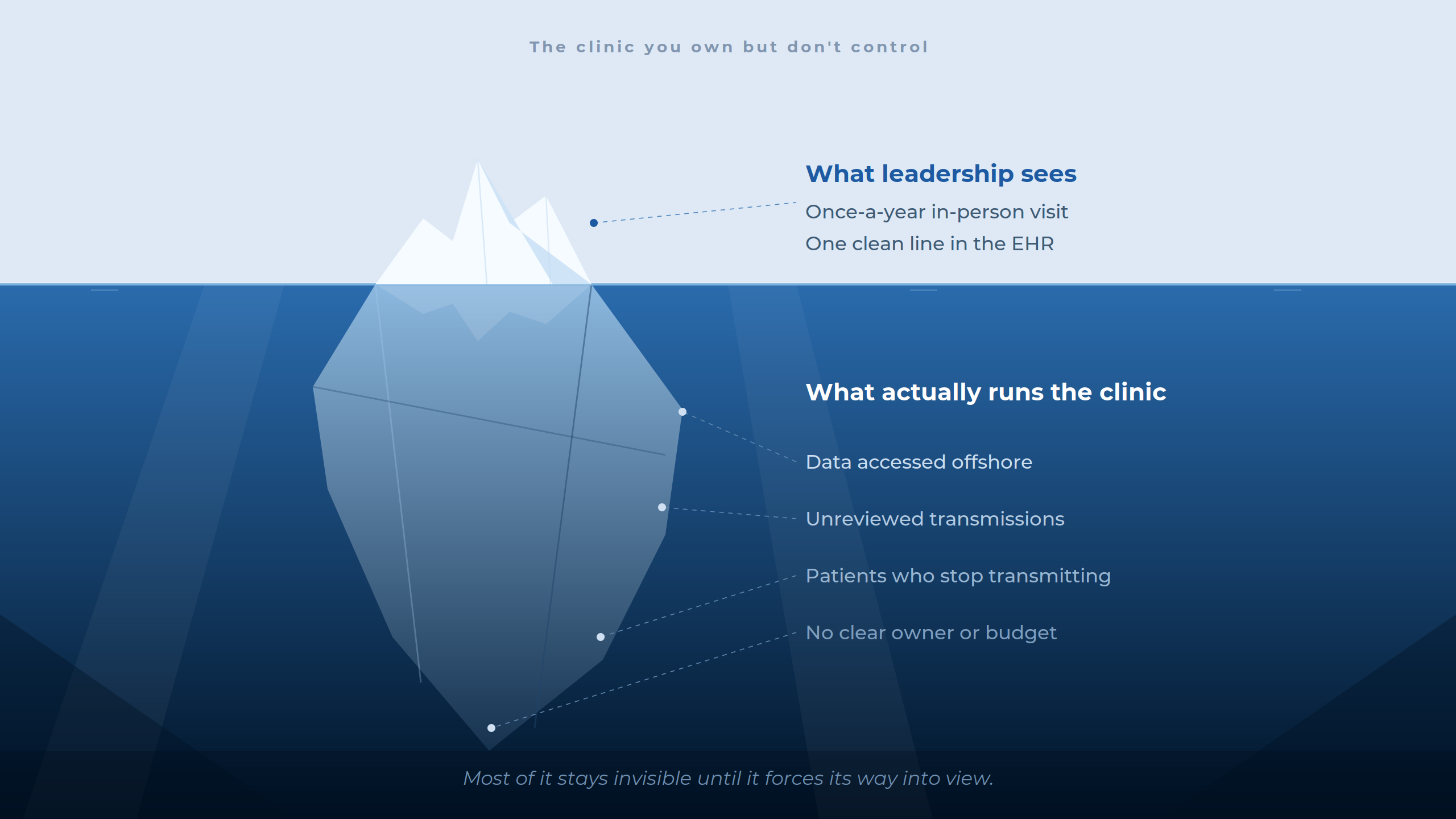
Iceberg diagram contrasting what leadership sees about the cardiac device clinic — a once-a-year in-person visit and one clean line in the EHR, above the waterline — with what actually runs it below the surface: data accessed offshore, unreviewed transmissions, patients who stop transmitting, and no clear owner or budget.

So what?

These are real problems, and they need real management, not reassurance. The same clinic that generates this risk is also, run well, one of the highest-value service lines in the hospital. You cannot manage what you have never been shown, and most of these realities stay invisible until they force their way into view. What does it take to turn the list around – to get ahead of the risk these differences create and transform that same clinic into one of your health system’s strongest performers? That’s the question every health system should be asking.

Coming next: Taking Control of the Clinic You Own

Continue reading

The Current Perception of Cardiac Device Management Software in Device Clinics

In the realm of cardiac care, the role of device management software has become increasingly prominent. As clinics and healthcare providers strive to optimize patient outcomes, the reliance on technological solutions has grown. However, the current perception of device management software, primarily seen as a data-centric tool, may be limiting its potential. This blog seeks to explore how the market views device management software and to argue for a broader, more integrated approach in clinic operations.

The Conventional View of Device Management Software

Traditionally, device management software has been perceived primarily as a tool for managing the vast amounts of data generated by cardiac implantable electronic devices (CIEDs). This includes consolidating multiple vendor site transmissions, tracking patient device interactions, storing historical data, and facilitating routine checks. The prevailing view in the market has been to evaluate these tools based on their ability to handle and store data efficiently. With the proliferation of advanced technologies, this perception has led to a focus on features like being cloud-based, reducing clicks, centralized, and secure. While these are undoubtedly important, this narrow focus often overlooks the software’s potential to play a more expansive role in clinic management.

The Limitations of a Data-Only Approach

As essential as efficient data management is, focusing solely on this aspect does not address all the operational challenges faced by cardiac clinics. Cycles of high staff turnover, complex training requirements, and the increasing burden of remote monitoring during these cycles are just a few examples of the operational complexities that go beyond mere data handling. For instance, when clinics face staff shortages, a data management tool alone cannot solve the underlying issue of quickly onboarding new staff. Nor can it provide the specialized training required to manage the sophisticated needs of modern CIEDs effectively. Additionally, as remote monitoring becomes more prevalent, the sheer volume of data can overwhelm even the most robust data-centric systems, leading to delays and potential lapses in patient care.

The Need for an Integrated Approach

It’s time to rethink device management software. Beyond just managing data, imagine a solution that transforms the entire operational landscape of the CIED clinics. An integrated approach could dramatically enhance clinic functionality and efficiency.

Imagine a system that not only handles data but also seamlessly improves other key aspects of clinic operations, boosting both staff performance and patient care. The future of device management software involves broadening its scope to meet the evolving demands of cardiac care, ensuring that clinics not only manage their data but also optimize their overall operations. This is the future we envision—one where technology fully supports the complex needs of modern device clinic environments.

Recognizing these gaps, it becomes apparent that device management software should be re-envisioned to encompass more than just data handling. An integrated approach that combines data management with solutions for sourcing qualified staffing, training, and on-demand remote monitoring could transform the operational dynamics of cardiac clinics.

This approach would not only manage data efficiently but also enhance the overall functionality of clinics by:

  • Providing dynamic staffing solutions that adapt to clinic needs in real-time.
  • Offering built-in, up-to-date, CEU-accredited training modules directly within the software, ensuring all team members are proficient and current in their knowledge.
  • Integrating on-demand advanced remote monitoring tools, and experts that can intelligently flag issues and prioritize patient alerts based on risk assessment, thereby improving patient care and staff efficiency.

In conclusion, the current market perception of device management software as primarily a data repository is a narrow view that fails to leverage the full capabilities of modern technology. As the landscape of cardiac care evolves, so too must the tools we rely on. By expanding the role of device management software to include comprehensive clinic management functionalities, we can ensure that clinics are not only managing data but are also optimizing their operations and enhancing patient care.

Contact PrepMD today to learn more about our solutions and comprehensive approach.

AI in Cardiology, technology and healthcare

AI in Cardiology: A Tool, Not a Replacement

In the dynamic landscape of healthcare, Artificial Intelligence (AI) is emerging as a potential ally. For stakeholders in hospitals and clinics grappling with large volumes of data, AI presents an opportunity to enhance efficiency. This is particularly relevant in cardiology, where AI can assist in areas such as Electrophysiology and rhythm analysis.

AI and Cardiology: An Adjunct, Not a Substitute

AI’s role in cardiology is not to replace human expertise but to augment it, especially in the realm of implantable devices like Implantable Cardioverter Defibrillators (ICDs), Pacemakers, and Implantable Loop Recorders (ILRs). These devices generate a wealth of data that can be overwhelming. AI can help manage this data, identifying patterns and anomalies that might be overlooked due to the sheer volume of information.

One of the key applications of AI in Cardiac Implantable Electronic Devices (CIED) practice is reducing false positives. By doing so, AI can help manage data overload without missing genuine positive findings. This can make the process of rhythm analysis more efficient, but it does not eliminate the need for expert human analysis.

LLM, ML, and DL: The AI Trio

Understanding how AI works in this context requires differentiating between Large Language Models (LLM), Machine Learning (ML), and Deep Learning (DL).

LLMs are AI models trained on a vast amount of text data. They can generate human-like text based on the input they receive. In cardiology, LLMs could be used to interpret patient data and generate reports, but these would still need to be reviewed and validated by healthcare professionals. LLMs are particularly useful in processing and understanding natural language, making them ideal for tasks such as reading patient histories or interpreting doctor’s notes.

ML is a subset of AI that uses statistical methods to enable machines to improve with experience. In cardiology, ML could be used to predict patient outcomes based on historical data, but these predictions would need to be evaluated in the context of each individual patient by a healthcare professional. ML algorithms can learn from data and make predictions or decisions without being explicitly programmed to perform the task. This makes them useful for tasks such as identifying patterns in heart rhythms or predicting the likelihood of a cardiac event based on patient data.

DL is a subset of ML that uses neural networks with many layers. DL can be used in cardiology to analyze complex data from imaging or ECGs, for example, but the interpretation and final decision-making should still lie with healthcare professionals. DL models are capable of learning from unstructured data and can identify complex patterns, making them ideal for tasks such as interpreting cardiac imaging data or detecting anomalies in ECG readings.

The Future of AI in Cardiology: A Balanced View

While AI holds promise for the future of cardiology, it’s crucial to remember that it’s a tool, not a replacement for human expertise. The development of AI is ongoing, and while it can assist in data analysis and decision-making, it cannot replace the need for human validation. The best patient outcomes are achieved when AI is used as a tool to assist healthcare professionals, not replace them.

In conclusion, AI can be a valuable asset in cardiology, but it’s not a magic bullet. As we explore this exciting frontier, it’s essential to remember the irreplaceable value of human expertise and validation. AI can be a powerful tool in our arsenal, but like all tools, it must be used wisely and responsibly, always in conjunction with human insight.

It’s important to partner with a company like PrepMD that not only delivers experts in the field of rhythm analysis, but also is actively building a software platform with strategic consideration and a focus on better patient outcomes.