
Taking Control of the Clinic You Own
Taking Control of the Clinic You Own
How the cardiac device clinic turns from a source of hidden risk into one of your strongest performers. Part 2 of 2.
By Jack Collier, CTO, PrepMD
The first post was the uncomfortable read: a clinic that sits inside your walls, runs on your network, carries your name on its liability, and quietly breaks nearly every rule the rest of your systems follow. This post is the other side of that same ledger. The very things that make the device clinic strange – its fragmentation, its recurring data, its clinical density – are also what make it one of the most valuable operations in your building, once they are brought under control.
Here is what is on the table, and what unlocks each one.
| Opportunity | What it costs you today | What unlocks it |
|---|---|---|
| Close the charge-capture leak | Billable monitoring that never gets coded | One integration in place of four |
| Grow the panel without growing payroll | Enrollment capped by manual, portal-by-portal triage | Consolidated, automated triage |
| Retain and ramp your certified staff | An onboarding treadmill on top of the four-portal grind | Unified tooling and a real training pathway |
| Feed the procedural pipeline | High-value findings buried in vendor portals | Consolidated data that surfaces them |
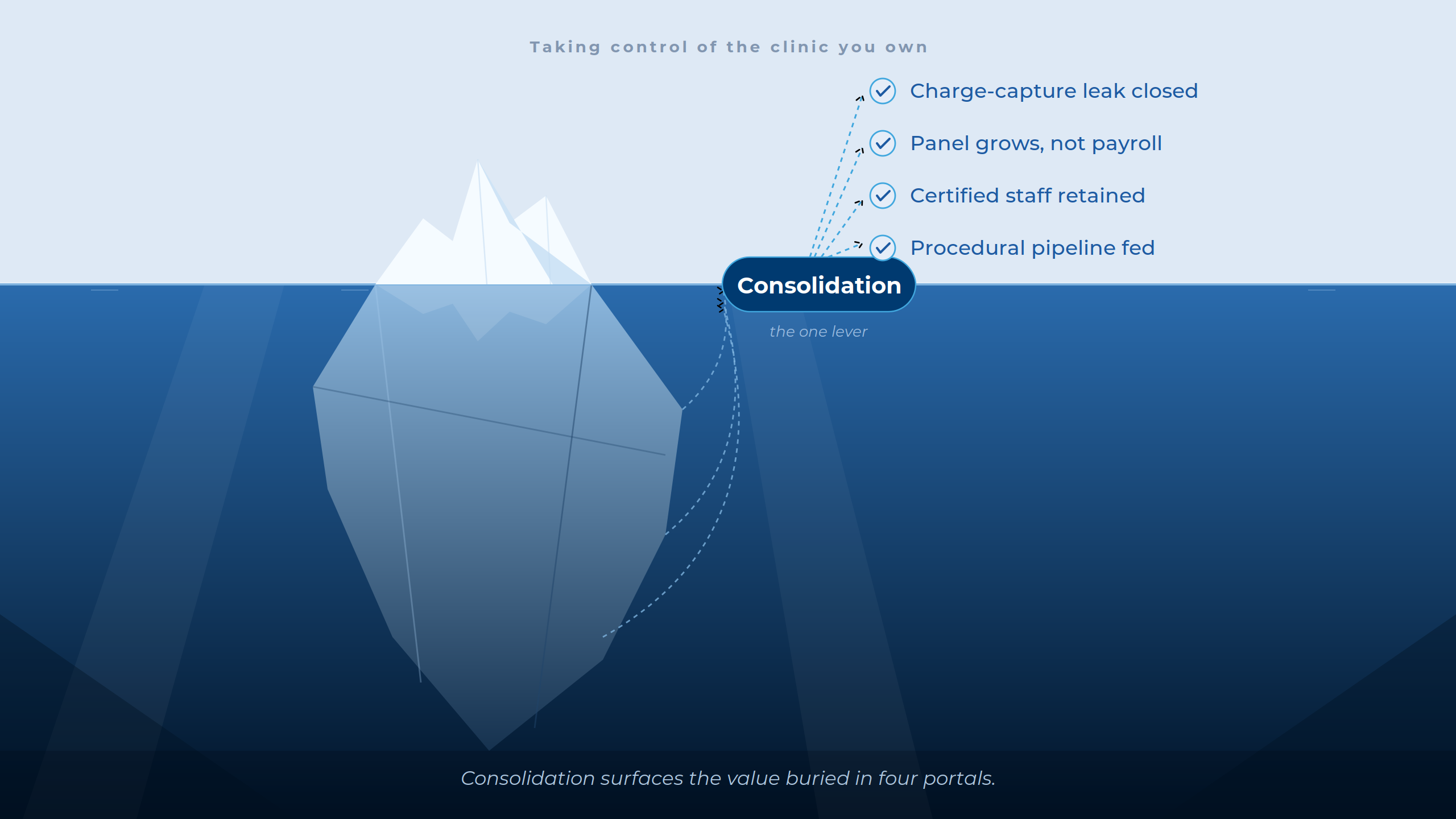
Read the right-hand column top to bottom and you have the whole argument: every opportunity resolves to the same lever.
Close the charge-capture leak
Post one established that device data breaks the tidy order-to-result-to-charge sequence your systems assume. That break is not just an integration headache. It is a revenue leak. Remote monitoring is billable on a recurring basis, but when transmissions arrive with no order behind them and scatter across four portals, capturing the charge depends on someone manually reconciling what was done with what can be coded. Work that was genuinely performed simply never gets billed. The fix is structural rather than a matter of trying harder: when the monitoring data and the billing logic live in one workflow, the charge follows the work on its own. You are not leaving money on the table so much as leaving it in four portals nobody reconciled.
Grow the panel without growing payroll
Remote monitoring is recurring revenue by design, and the device panel only ever gets larger. The catch is that if every new enrollment adds manual triage across separate portals, your growth is capped by coordinator hours rather than by demand. Consolidated, automated triage changes the math: surface the minority of transmissions that are actionable, suppress the noise, and the same team carries a materially larger panel. One honest caveat belongs here. You can only bill and grow what is actually connected, and a device that has gone quiet for days is genuinely ambiguous, so improving your connected rate matters alongside adding names. Recurring revenue should scale with your panel, not with your headcount.
Retain and ramp your certified staff
IBHRE-certified device clinic specialists are scarce, expensive to replace, and prone to leaving, and clinics carry heavy turnover. Burnout here is not one problem but several stacked together: the four-portal grind, alert fatigue from a stream where roughly three quarters of alerts are non-actionable, a heavy documentation load, and highly credentialed people spending their day on clerical work beneath their license. Turnover then forces leaders into a perpetual onboarding cycle, and standing up training in-house becomes its own distraction from running the clinic. Not all of this is yours to solve; compensation and staffing ratios sit elsewhere. But a large share of what drives these staff out is workflow, and workflow is exactly what tooling and a structured training pathway address. Much of what pushes certified staff out the door is fixable in the tools they are handed.
Feed the procedural pipeline
The device clinic is quietly the best early-warning system in your cardiac service line. Its data surfaces generators nearing end of service, lead issues, upgrade candidates, and arrhythmias that point toward ablation – findings that otherwise sit unread in a portal nobody consolidated. Surface them promptly and the right patients move through your own EP and cardiology programs sooner, instead of leaking to a competitor or surfacing later as an avoidable admission. Your lever is not the procedure itself; it is the analytics and the surfacing that put the finding in front of a clinician while it still matters. Run well, the device clinic is not a cost center to contain but the demand engine for your highest-value cardiac care.
What it actually takes
Notice that every opportunity above resolved to the same word: consolidation. The charge leak closes when billing and monitoring share a workflow. The panel scales when triage is consolidated and automated. Staff stay when the tooling is unified and the training is built in rather than bolted on. The pipeline fills when findings are surfaced from one place instead of four. The differences that made the device clinic hard in post one all trace back to fragmentation, and so does every opportunity to turn it around.
That is the case for treating the device clinic as one consolidated operation rather than four vendor portals and a staffing problem. It is also, candidly, the model PrepMD is built around: PrepMD OMNI, a clinician-built platform that unifies remote monitoring workflows, recalls, billing, and analytics, with integrated CEU-accredited education that accelerates staff onboarding and competency development; a U.S.-based, IBHRE-certified remote monitoring team; and flexible in-clinic staffing to support turnover and fluctuating patient volumes. Few vendors, if any, bring all of these capabilities together, and that combination is the entire point. The opportunities in this post are unlocked by consolidation, and consolidation is hard to reach when the pieces come from separate vendors who talk to each other no better than the device portals do.
The other side of the ledger
Post one was the version you would rather read first: a clinic you own but do not control, quietly breaking the rules the rest of your environment follows. This is the other side of the same ledger. You cannot manage what you have never been shown. Now that you have seen it, the device clinic stops looking like a liability to contain and starts looking like one of the best opportunities in your building.

